 汉语
汉语
 English
 Français
 Deutsch




How can semiconductor manufacturers measure liquid-borne particles below 20 nm?
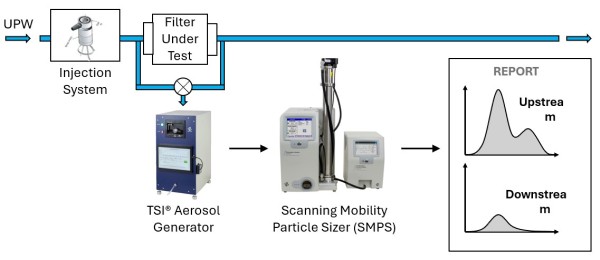
TSI’s Aerosol Generator + Scanning Mobility Particle Sizer (SMPS) applies established aerosol measurement techniques to liquid samples, enabling particle number concentration and size distribution measurements below 20 nm—and, in some configurations, down to below 2.5 nm. This provides size-resolved data for characterizing liquid filter retention, evaluating UPW and process liquid cleanliness, and supporting data-driven filter qualification and replacement decisions.
Table of Contents
1. Why Semiconductor Teams Choose This Solution?
Sub-20 nm Particle Number Concentration & Sizing
Contamination at the nanoscale can be invisible to conventional liquid particle counters, which typically have limitations around 20 nm and may be affected by bubbles, mixed particle populations, and particle composition. TSI’s Aerosol Generator + Scanning Mobility Particle Sizer (SMPS) solution applies established aerosol science to liquid filtration, enabling sub-20 nm particle number concentration and sizing with high-resolution, composition-independent measurements. This provides semiconductor engineers with detailed data to support filter selection, qualification, and replacement decisions.
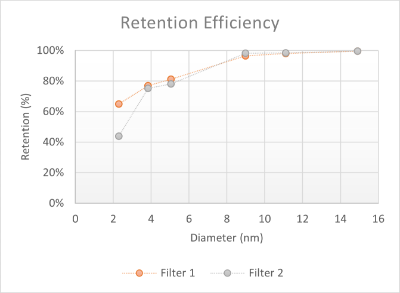
- Sub-20 nm Particle Sizing: Measure filter retention at particle sizes no optical instrument can reach. Identify pass-through contamination before it reaches the wafer — not after yield loss appears.
- Multi-Modal Size Distributions: Accurately resolve complex, multi-peak particle populations in a single scan. Know exactly what your filter is — and isn't — capturing, across the full size range.
- Filter Lifetime Quantification & Rinse-Down Readiness: Eliminate guesswork from filter change intervals. Generate data-driven loading curves that tell you when a filter is truly ready — reducing both premature replacement cost and the risk of running a degraded filter.
- No Bubble Miscount: Aerosol-based detection cannot register bubbles as particles — a known failure mode of optical instruments that can trigger false alarms or, worse, mask real contamination events.
- Independent of Refractive Index: Results are unaffected by optical particle properties
- Metrology-Grade Technique: CPC/SMPS methods are used by national metrology laboratories worldwide. Results that hold up to scrutiny — in qualifications, audits, and supplier conversations.
2. How It Compares to Traditional Techniques
| Attribute | Liquid Particle Counter | TSI® Aerosol Generator + SMPS New |
|---|---|---|
| Min. detectable size | 20 nm | <20 nm |
| Size resolution | ~4 channels | >100 channels |
| Bubble interferance | Yes | None |
| Multi-modal accuracy | None | High |
| Refractive index dependent | Yes | Independent |
| Metrology traceability | Partial | Established |
3. Applications for Semiconductor Professionals
Every application below maps directly to yield protection or risk reduction in your fab:
- Filter Qualification & Efficiency Testing - Particle retention characterization by size down to below 2.5 nm.
- UPW Filtration Efficiency - Quantify ultrapure water filter performance below 20 nm — the size regime where conventional counters go blind and contamination risk is highest.
- Filter Lifetime & Replacement Decisions - Replace filters on evidence, not schedule. Data-driven replacement intervals reduce both over-spend and the risk of a degraded filter reaching critical process steps.
- High-Purity Chemical & Liquid QC - Extend the same sub-nm insight to specialty chemicals, solvents, and process liquids — anywhere an uncharacterized particle population is an unacceptable risk.
4. Measurement Setup and Results
5. Ready to protect yield at the nanoscale?
Click Here to Learn More About the Scanning Mobility Particle Sizer!