 汉语
 English
 Français
 Deutsch



Direct Answer: The TSI 3750200 Sampling System supplies up to four UFP instruments in parallel from a single aerosol inlet, maintaining constant size-dependent losses regardless of how many instruments are connected or removed. It is the first aerosol sampling system to have its losses comprehensively characterized — both theoretically and experimentally — and is readily available to fully comply with EN 16976:2024, CEN/TS 17434:2020, and ACTRIS requirements.
Published as poster presentation at the Symposium "Ultrafeine Partikel in der Außenluft und in Innenräumen" (UFP Symposium), Berlin 2026.
Table of Contents
- Why the sampling system is the foundation of reliable UFP monitoring
- The TSI 3750200 Sampling System: design and core capability
- The first comprehensively characterized aerosol sampling system
- Versatility beyond standard regulatory configurations
- Compliance summary
- Conclusion: Sampling System as Prerequisite of UFP Monitoring Stations
- References
1. Why the sampling system is the foundation of reliable UFP monitoring
The revised EU Ambient Air Quality Directive (AAQD) requires member states to monitor ultrafine particles (UFPs) in urban areas — specifically, both particle number concentration (PNC) and particle size distribution (PSD) — as part of a broader effort to better understand the health effects of air pollution. At so-called supersites, monitoring stations must be equipped with parallel measurement systems for both PSD and PNC simultaneously. The same requirement applies to ACTRIS infrastructure monitoring stations conducting UFP measurements.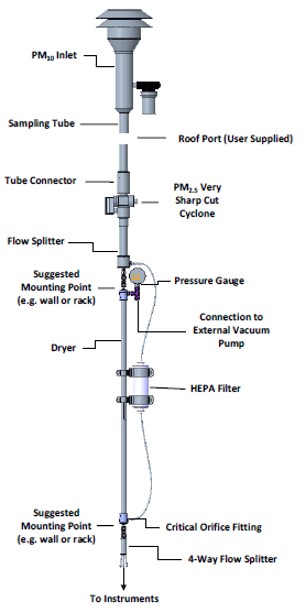
This parallel instrument configuration creates a challenge that is easy to overlook: how do you ensure that two, three, or four instruments connected to the same sampling inlet are all measuring the same aerosol sample — and continue to do so reliably when instruments are added, removed, or exchanged over time? The answer lies not in the measurement instruments themselves, but in the sampling system that feeds them.
Operators responsible for multiple monitoring stations face an additional layer of complexity. Quality assurance procedures — including round robin tests, internal validation exercises, and comparison tests between stations — require that sampling conditions remain consistent and well-characterized across configurations. Future changes in regulatory requirements, such as the addition of sub-10 nm measurement capability, add further demands on sampling system flexibility.
2. The TSI 3750200 Sampling System: design and core capability
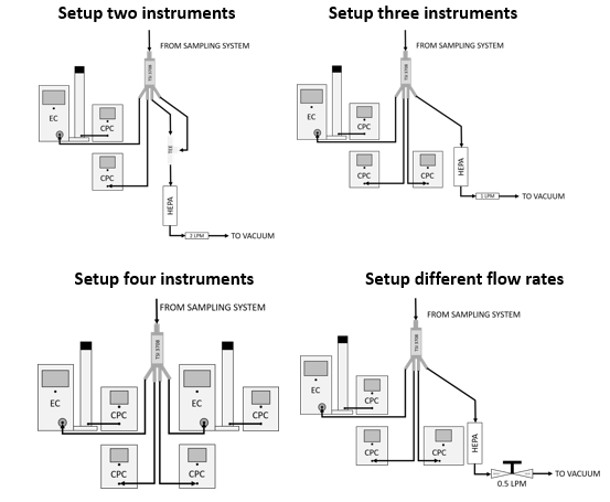
The TSI 3750200 was designed specifically to address these requirements. Its core function is to draw a constant aerosol flow of 4 liters per minute (L/min) and supply it to one, two, three or four UFP instruments in parallel, via a four-way flow splitter (Model 3708, TSI) — the same splitter widely used in laboratories for instrument validation and calibration.
The system's key insight is that by maintaining a constant internal aerosol flow of 4 L/min regardless of the number of instruments connected, the size-dependent losses caused by the sampling line and its components remain stable. Whether one instrument or four are drawing from the system, losses stay within the efficiency limits defined by EN 16976:2024. This means long-term datasets remain comparable even when instrument configurations change between stations or over time — a critical requirement for network-level data quality assurance.
Beyond flow management, the system handles two further prerequisites for compliant UFP measurement:
- Particle size selection: Larger particles are removed upstream using a PM10 sampling head and, optionally, a PM2.5 cyclone (both BGI Mesa Labs Inc.), ensuring that only the relevant particle size fraction reaches the downstream instruments.
- Aerosol drying: EN 16976:2024 requires that the aerosol sample entering a CPC inlet has a relative humidity below 40%. The 3750200 achieves this using a single-tube Nafion membrane dryer, conditioning the sample before it reaches the flow splitter. Losses for the complete inlet system remain below 25% at a particle diameter of 10 nm, and below 30% at 7 nm — within the limits set by the standard.
3. The first comprehensively characterized aerosol sampling system
A fundamental distinction separates aerosol sampling systems from the measurement instruments they serve: while PNC and PSD instruments are subject to calibration at national metrology institutes (NMIs) or recognized calibration centers such as the WCCAP at TROPOS, sampling lines are not. Historically, losses in sampling systems have been estimated based on equivalent tubing lengths for individual components — not determined experimentally under realistic operating conditions.
The TSI 3750200 is the first aerosol sampling system to have its size-dependent losses characterized both theoretically and experimentally under real conditions. This work was carried out in collaboration with Forschungszentrum Jülich, using the SAPHIR STAR (STirred Atmospheric tank Reactor) chamber facility, where the sampling system inlet was compared directly against a reference port using two PSD and two PNC instruments simultaneously (Models 3938W89 and 3789, TSI). The resulting size-dependent efficiency curves — covering a range of aerosol types generated under controlled chamber conditions — provide users with documented, traceable performance data that is not available for conventional sampling approaches.
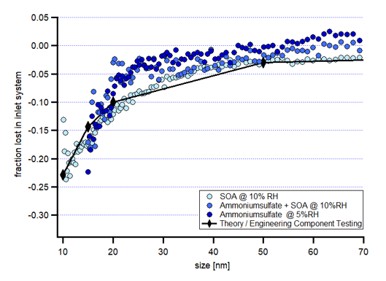
Fig 1: Size dependent efficiency of the TSI 3750200 sampling solution for different aerosol types generated in a chamber.
4. Versatility beyond standard regulatory configurations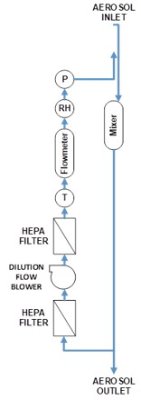
While the 3750200 is designed primarily for parallel CPC and SMPS deployments in regulatory UFP monitoring, the same sampling platform can be adapted for more demanding research applications.
High-pollution environments
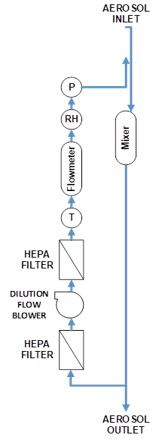
At monitoring stations near traffic junctions, airports, seaports, or industrial sources — the priority locations identified in the AAQD — aerosol concentrations can exceed the single-particle counting range of a CPC. An active dilution option based on the Aerosol Diluter (Model 3333-10, TSI) can be added to the sampling system for these deployments. The diluter follows the design recommendations of CEN/TS 17434, maintains an active dilution ratio of 10:1, and integrates with the CPC via a plugin for continuous dilution monitoring and status reporting. It is built using proven components from the TSI Classifier 3082, ensuring long-term reliability in continuous operation.
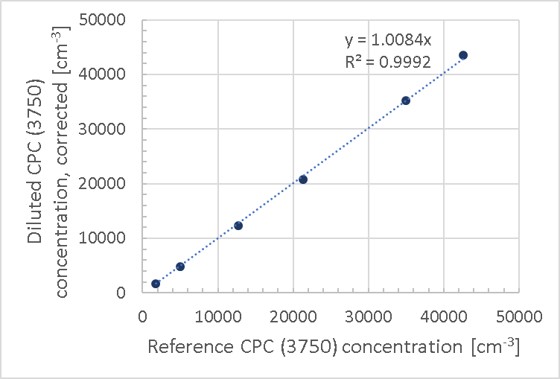
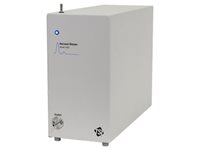
Fig 2: Performance of the Diluter
Transient process monitoring
Applications such as ship plume emissions require fast particle size distribution measurements that may also span the supermicrometer size range. A modified sampling configuration supports the FMPS 3091 (TSI) fast sizing spectrometer operating at 10 L/min alongside supermicrometer PSD systems such as the OPS 3330 (TSI) or APS 3321 (TSI) operating at 1 or 5 L/min — instruments with significantly different flow rate requirements that a standard four-way splitter could not accommodate without modification.
5. Compliance summary
The TSI 3750200 Sampling System fully meets the requirements defined in EN 16976:2024 and CEN/TS 17434:2020, as well as ACTRIS infrastructure standards for UFP sampling. Specifically:
- Size-cut performance within standard limits (PM10 head; optional PM2.5 cyclone)
- Losses below 25% at 10 nm and below 30% at 7 nm across the full inlet system
- Relative humidity control to below 40% via Nafion membrane dryer
- Constant 4 L/min aerosol flow maintaining stable size-dependent losses across one to four connected instruments
- Dilution option compliant with CEN/TS 17434 design recommendations
6. Conclusion: Sampling System as Prerequisite of UFP Monitoring Station
The sampling system is often the least visible component of a UFP monitoring station — but it is the prerequisite on which every downstream measurement depends. The TSI model 3750200 addresses this directly: it helps ensure that multiple instruments measure the same aerosol sample, that losses remain constant and characterized regardless of instrument configuration, and that the system meets the requirements of both CEN standards and ACTRIS infrastructure specifications.
For monitoring network operators facing the demands of AAQD supersites, ACTRIS station requirements, and ongoing quality assurance programs, a sampling system with documented, experimentally validated performance is not a convenience — it is a foundation.
7. References
Schmitt et al. (2024). In-depth characterization of an ambient sampling inlet system at the steady-state SAPHIR-STAR chamber. EAC 2024, Tampere.
Tritscher et al. (2021). Harmonization of UFP measurements: Characterization of primary components of an inlet sampling system. EAC 2021, Birmingham.
EN 16976:2024. Ambient air — Determination of the particle number concentration of atmospheric aerosol.
CEN/TS 17434:2020. Ambient air — Determination of the particle size spectra of atmospheric aerosol using a Mobility Particle Size Spectrometer (MPSS).
Wiedensohler et al. (2012). Mobility particle size spectrometers: Harmonization of technical standards and data structure. Atmospheric Measurement Techniques.