 汉语
 English
 Français
 Deutsch




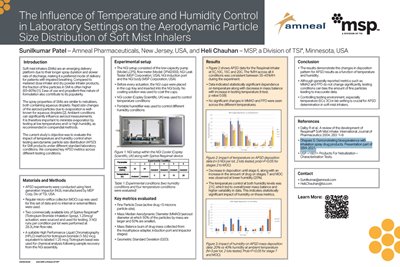 Soft mist inhalers (SMIs) are increasingly favored for drug delivery due to their prolonged spray duration and slower discharge rate, which benefit patients with impaired breathing. Compared to metered dose inhalers and dry powder inhalers, SMIs often exhibit a higher fraction of fine particles, typically ranging from 65% to 80%1. Their ease of use and propellant-free formulations further enhance their popularity.
The spray properties of SMIs resemble those of nebulizers, as both release aqueous droplets. It is well-documented that the aerosol particles of aqueous droplets undergo rapid size changes due to evaporation2. Ambient conditions, particularly temperature and humidity, can significantly affect aerosol measurements. To minimize evaporation, it is crucial to conduct tests at low temperatures and/or high humidity, as recommended by compendial methods.
This study aims to evaluate the impact of temperature and humidity control on the aerodynamic particle size distribution (APSD) of SMI products under various standard laboratory conditions. We compared key APSD metrics across different testing environments to understand the influence of these factors better.
The results demonstrate the changes in deposition pattern for APSD results as a function of temperature and humidity. Learn more and view the poster.
Scientific Poster Presented at RDD 2024
References:
[1] Dalby R et al.: A review of the development of Respimat® Soft Mist Inhaler. International Journal of Pharmaceutics 2004, 283: 1–9.
[2] Dhapare S: Demonstrating bioequivalence with inhalation spray drug products. Presentation part of SBIA 2021.
Why Choose MSP's Next-Generation Impactor (NGI/NGI+) for APSD Testing?
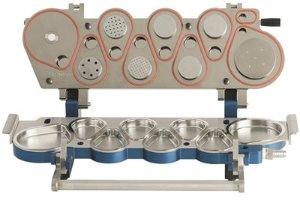 Precise APSD Characterization: Accurate, reliable measurements across a wider range of drugs and delivery systems.
- Enhanced Durability: Superior corrosion resistance and chemical compatibility make it ideal for nebulizers, dry powder, and high-saline formulations.
- Robust Cleaning Options: Compatible with automated cleaning and harsh cleaning agents, reducing cross-contamination risk and cleaning time.
- Seamless Integration: Upgrade your existing NGI without disrupting your workflow, and extend the life of your equipment.