 汉语
汉语
 English
 Français
 Deutsch




Direct Answer: Manufacturers of P100, FFP3, and P3-class filters must ensure every unit meets stringent quality standards before leaving the production line. This guide explores the importance of inline filter testing, the applicable standards, and how the TSI Automated Filter Tester Model 8150 revolutionizes high-throughput production.
Table of Contents
1. Why inline production filter testing matters
Highly efficient respiratory protective devices — including P100 (North America) and P3/FFP3 (Europe) respirators and filter cartridges — are governed by standards that mandate individual unit testing. In North America, the applicable regulation is 42 CFR 84; in Europe it is EN 143 and EN 149.
The primary purpose of production-line testing is not to replicate the comprehensive certification process performed in the laboratory. Rather, it is to catch manufacturing defects — pinholes, seal failures, incorrectly seated media — before products reach the end customer. A filter tester is therefore typically integrated at the end of the production line, where it checks each unit automatically and flags any that fall outside specification.
| Key distinction: Lab certification verifies a product design meets a standard. Inline production testing verifies that each manufactured unit is free from defects introduced during fabrication. |
2. Key requirements from filter manufacturers
In conversations with customers across the industry, five requirements consistently emerged as priorities for an inline production filter tester:
Req. 1 Fast measurement time: Test time of 10 seconds or less to keep pace with line throughput. In some applications, less than 10 seconds is needed.
Req. 2 Comparable results to the lab: Results must agree — not merely correlate — with those from quality control lab instruments such as the model 8130A Automated Filter Tester.
Req. 3 High durability: Any production downtime carries real cost. The tester must be highly reliable and maintainable without halting the line.
Req. 4 Compact footprint: Space around existing production lines is often limited. The instrument must fit into constrained environments.
Req. 5 Easy PLC integration: Reliable, standards-based data communication to the production line control system is essential for automation.
3. Inside the model 8150 Automated Filter Tester: design and components
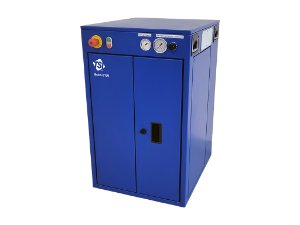 The 8150 is an oil-only automated filter tester designed for remote, unattended operation in production environments. Its design deliberately preserves key components from the 8130A — the de facto standard in quality control laboratories and certification testing — to ensure measurement agreement between the two platforms.
Dual simultaneous photometers
The 8150 uses two photometers — one upstream, one downstream — operating simultaneously. This matters because all aerosol generators exhibit some fluctuation in output concentration over time. By measuring both concentrations at the same instant, the instrument eliminates the effect of any drift, producing more accurate and reproducible results than a sequential measurement approach would allow.
The photometers are housed in a self-contained, modular photometer box that can be removed from the main unit and positioned close to the filter holder on the production line. This minimizes the length of tubing between the photometer box and the filter under test, which directly reduces measurement time.
Oil aerosol generator
The aerosol generator is functionally equivalent to that used in the 8130A, enabling direct comparison of results. The 8150 supports Paraffin oil (EN standards) as well as DEHS and DOP (North American standards).
An optional automated refill system allows the oil reservoir to be replenished without stopping the instrument — and even while a test cycle is in progress. A closed-loop recirculation circuit prevents contamination and significantly reduces overall oil consumption.
Flow range and pressure drop measurement
| Test flow rate range | 10 – 120 L/min (higher possible with an upgraded pump) |
|---|---|
| Pressure drop measurement | Simultaneous with penetration; alternative transducers available for non-standard pressure ranges |
| Dilution flow control | Mass flow controller — set once, monitored continuously via GUI |
| Communication | Modbus (detailed diagnostic data) + Ethernet (remote GUI access) |
| Aerosol challenge agent | Oil only (Paraffin, DEHS, DOP) |
Remote access via Ethernet
An Ethernet port allows any networked computer — or laptop placed directly on top of the unit — to display the full graphical user interface of the tester. Operators can monitor results, check diagnostic status, and review warnings from anywhere on the network, including from a remote support session with a TSI technician.
Serviceability
The photometer box is user-serviceable and can be cleaned at a time that does not disrupt production. The instrument's diagnostic system alerts the operator when cleaning is needed, rather than requiring scheduled maintenance on a fixed calendar.
4. Measurement speed: understanding cycle time
Cycle/test time is the total time required to complete all testing operations on one filter. It comprises four sequential steps:
- Install — Place the filter in the holder and close it.
- Rise / stabilization — Supply aerosol and wait until upstream and downstream concentrations stabilize to within ±10% of target.
- Measure — Record upstream and downstream photometer voltages and compute penetration and pressure drop.
- Remove — Unload the tested filter (typically simultaneous with loading the next unit).
Three factors have the greatest influence on cycle time:
Flow rate: At 32 L/min, a valid measurement is reached in approximately 4.5 seconds. Increasing the flow rate to 85 L/min reduces this to under 3 seconds — a meaningful improvement in high-throughput settings.
Tubing length: Longer tubing between the photometer box and the filter holder increases the air volume that must be moved before stable reading is achieved. Adding 1.5 m of tubing at 32 L/min adds roughly 0.5 seconds to the rise time. Removing the photometer box from the main unit and positioning it adjacent to the filter holder — even with a longer connection back to the instrument — yields a net reduction in cycle time because the critical measurement path is shortened.
Filter holder dead volume: Excess void volume in the filter holder has a similar effect to excess tubing. The recommendation is to design the filter holder so that it encompasses the cartridge or filter under test, with fast-acting seals and minimal internal volume. TSI can provide guidance to integrators on holder design.
| < 6 s | < 4 s | < 1.5 s |
| Consistent cycle time at 32 L/min in validation testing | Achievable with optimized tubing length and filter holder | Rise time for flat-sheet media at 99.95% efficiency, 32 L/min |
5. Comparability with the 8130A reference instrument
To validate result agreement, TSI conducted a rigorous comparative study under controlled laboratory conditions. Certified Green Line filter media samples were measured repeatedly across the 8130A reference filter testers and the 8150 units using a back-and-forth testing approach designed to assess repeatability and comparability. Because oil-based testing does not introduce a significant loading effect over short test durations, the same media samples could be used throughout the study without influencing the results.
Testing was performed across multiple stacked-sheet configurations to span a broad range of penetration values. The resulting data demonstrated excellent agreement between the 8150 and the established 8130A reference methodology. In addition, key measurement components, including photometer boxes and aerosol generators, were interchanged during testing to further confirm that the observed agreement was attributable to the underlying measurement architecture rather than instrument-specific variability.
| Green Line certified media is a planar filter material that TSI certifies and supplies specifically for quality-control verification of filter testing instruments. It allows in-house calibration checks to be performed quickly and traceably using the production line simulator accessory. |
6. Available models, maintenance and accessories
The 8150 is offered in four configurations to match different production environments and operational preferences:
| 8150 | 8150R | 8150N | 8150NR |
| Standard configuration. Oil aerosol generator, dual simultaneous photometers, Modbus and Ethernet. | Standard plus automatic aerosol generator refill for continuous operation without stopping the line. | Standard plus air ionizer. For customers who prefer a neutralized aerosol even when testing with oil. | Air ionizer and automatic refill combined. |
Production line simulator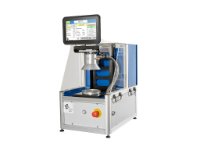
The 8150-PLS Production Line Simulator accessory replicates the filter holder geometry used on the 8130A and connects to the 8150 via quick-connect fittings. It serves three purposes:
- It allows the 8150 to be serviced and verified off-line without interrupting production.
- It enables periodic in-house calibration checks using certified Green Line media
- It simplifies troubleshooting by isolating the instrument from the production environment.
Maintenance and other accessories
Maintenance parts kits (including O-rings and internal filters), individual replacement components, and an external vacuum panel for facilities without a centralized vacuum supply are all available from TSI.