 汉语
汉语
 English
 Français
 Deutsch




Direct Answer: Semiconductor fabrication demands the world’s most rigorous contamination control — and the series of ISO 14644 standards set the global benchmark for cleanrooms. Reliable achievement and maintenance of these standards support high yield, process efficiency, and regulatory adherence. This guide outlines essential steps for electronics and semiconductor manufacturers to meet ISO 14644 requirements with actionable strategies and industry-specific insights.
Table of Contents
- Understanding ISO 14644 For Semiconductor Cleanrooms
- Designing and Building According to ISO 14644
- Implementing Advanced Environmental Monitoring
- Developing and Enforcing SOPs For Fab Operations
- Routine Testing and Validation Protocols
- Responding to Non-Conformity and Driving Continuous Improvement
- Advancing Toward Sustainable Compliance
- Summary: ISO 14644 Compliance for Semiconductor Manufacturing
Understanding ISO 14644 For Semiconductor Cleanrooms
ISO 14644 defines cleanroom classifications based on airborne particulate concentration, a critical factor for process yield and device reliability in wafer fabs, packaging facilities, and test areas. Semiconductor manufacturing consistently requires tighter cleanliness, typically ISO Class 1, 3, or 5, especially for photolithography, wafer etch, and deposition steps, with each class representing progressively tighter particle control:
- ISO Class 1: ≤10 particles (≥0.1 μm) per cubic meter. Required for extreme ultraviolet (EUV) lithography, cutting-edge wafer production.
- ISO Class 3: ≤1,000 particles (≥0.1 μm) per cubic meter. Typical for front-end fab areas.
- ISO Class 5: ≤100,000 particles (≥0.1 μm) per cubic meter. Suitable for sub-fab, gowning, and support zones.
Essential ISO 14644 Documents for Semiconductor Manufacturers
A range of documents in the ISO 14644 family target contamination control priorities for advanced electronics and semiconductor cleanrooms:
ISO 14644-1:2015 – Classification of air cleanliness by particle concentration. Defines particle size classes and contamination limits, and includes methods and reporting for airborne particulate contamination.
ISO 14644-1 Particle Contamination Levels (simplified) |
||||||
| ISO Class number (N) | Maximum allowable concentrations (particles/m³) for particles equal or greater than the considered sizes | |||||
| 0.1µm | 0.2µm | 0.3µm | 0.5µm | 1.0µm | 5.0µm | |
| 1 | 10 | |||||
| 2 | 100 | 24 | 10 | |||
| 3 | 1000 | 237 | 102 | 35 | ||
| 4 | 10000 | 2370 | 1020 | 352 | 83 | |
| 5 | 100000 | 23700 | 10200 | 3520 | 832 | |
| 6 | 1000000 | 237000 | 102000 | 35200 | 8320 | 293 |
| 7 | 352000 | 83200 | 2930 | |||
| 8 | 3520000 | 832000 | 29300 | |||
| 9 | 35200000 | 8320000 | 293000 | |||
ISO 14644-2:2015 – Monitoring methods, frequency, and ongoing compliance assessment.
ISO 14644-3:2019 – Test methods for cleanroom validation.
ISO 14644-4:2022 – Guidance on design, construction, and start-up of cleanrooms.
ISO 14644-5:2025 – Operational best practices for maintaining standards.
ISO 14644-7:2004 – Separative devices, including mini-environments and isolators.
ISO 14644-9:2022 – Surface cleanliness for critical environments.
ISO 14644-12:2018 – Monitoring nanoscale contamination, requiring condensation particle counting for <100nm particles.
ISO 14644-16:2019 – Strategies for energy efficiency in cleanrooms.
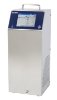 For real-time nanoscale particle monitoring, especially for contaminants smaller than 100 nm, condensation particle counters such as the TSI 9001 AeroTrak™ Cleanroom Condensation Particle Counter are industry standards. This technology enables reliable detection and control of ultrafine contamination in both ambient air and process gas lines. For real-time nanoscale particle monitoring, especially for contaminants smaller than 100 nm, condensation particle counters such as the TSI 9001 AeroTrak™ Cleanroom Condensation Particle Counter are industry standards. This technology enables reliable detection and control of ultrafine contamination in both ambient air and process gas lines. |
Additional Semiconductor-Specific Requirements
- Continuous monitoring of sub-micron and nano-scale particles is required for yield control.
- Airborne molecular contamination (AMC) detection (acids, bases, VOCs, dopants) helps protect sensitive device layers.
- Routines for equipment monitoring, material handling, and personnel protocols are necessary to maintain control over all routes of contamination.
- Automated calibration and data traceability align with both ISO 14644 and industry guidelines such as IEST-RP-CC and SEMI E-series.
By integrating these standards and technologies, fabs can optimize environmental controls, minimize particle excursions, and streamline compliance with customer and regulatory benchmarks. This enables high-yield manufacturing, reliable audit outcomes, and industry leadership in contamination management.
Designing and Building According to ISO 14644
Effective cleanroom design is central to defect prevention and yield protection. For semiconductor manufacturing, the following areas are mission-critical:
- Airflow Patterns: Laminar, unidirectional airflow across process tools to minimize turbulence and particle deposition.
- Filtration: Use of ULPA filters with ≥99.9995% efficiency for ≥0.12 μm particles in critical zones; HEPA filters may be suitable in support areas.
- Material Selection: Low-outgassing, antistatic, and easily cleanable surface finishes. Avoidance of exposed particle traps.
- Layout Optimization: Minimize personnel paths through critical process areas; segregate gowning, sub-fab, and maintenance corridors.
Construction Best Practices: During construction, implement comprehensive cleaning and verification at the completion of each stage to uphold contamination control standards. Apply rigorous protocols for the movement of materials, tools, and personnel to minimize the introduction of particulates. Before moving in process equipment, conduct full-scale leak testing, airborne particle verification, and room pressurization checks to confirm compliance with critical cleanroom specifications.
Implementing Advanced Environmental Monitoring
Advanced, integrated monitoring systems are the backbone of semiconductor compliance and quality assurance. Continuous tracking supports rapid detection and correction, reducing scrap and unplanned downtime. Core monitoring solutions include:
- Real-Time Particle Counters: Deployed at process tool exhausts, return air ducts, and critical tool interfaces for granular, zone-specific measurement.
- Environmental Sensors: Temperature, humidity, pressure differential sensors networked for centralized monitoring; enable BMS integration.
- AMC (Airborne Molecular Contamination): Specialized sensors for acids, bases, VOCs, and dopant molecules, crucial for preventing photoresist poisoning and device damage.
Operational best practices include setting alarm thresholds for each parameter in alignment with defined process tolerances, automating data collection, reporting, and trend analysis to support actionable insights, and maintaining instrument calibrations according to manufacturer-recommended schedules with clear traceability to recognized standards.
Developing and Enforcing SOPs For Fab Operations
Comprehensive, actionable standard operating procedures ensure consistent compliance and operational discipline for all staff and contractors.
- Personnel Protocols: Strict gowning sequences, air showers, and health monitoring. Enforce exclusion policies for sickness.
- Equipment Handling: Control and cleaning specifications for process tools, wafer handling robots, and maintenance activities.
- Cleaning and Maintenance: Scheduled wet and dry cleaning for all surfaces with approved agents; include detailed frequency, verification, and escalation steps.
- Event Response: Procedures for power loss, HVAC system alarms, or process room contamination events.
Training programs should reinforce these procedures through onboarding, refreshers, and competency verification, with documentation maintained for audit readiness.
Routine Testing and Validation Protocols
ISO 14644 compliance requires periodic verification that cleanroom performance remains within specification. In semiconductor fabs, validation typically includes:
- Particle concentration mapping under at-rest and operational conditions
- HEPA and ULPA filter integrity testing
- Airflow velocity and volume measurements
- AMC testing in sensitive process areas
- Recovery time assessments following maintenance or simulated contamination events
All results, deviations, and corrective actions should be fully documented and retained to support audits, customer reviews, and internal process control.
Responding to Non-Conformity and Driving Continuous Improvement
When cleanroom conditions fall outside specification, rapid and structured response is critical. Effective programs follow a defined progression—from immediate containment and root cause analysis to remediation and re-verification.
Beyond corrective action, continuous improvement relies on trend analysis, management review of monitoring data, and periodic benchmarking against evolving industry practices and standards.
Advancing Toward Sustainable Compliance
ISO 14644 compliance is an ongoing operational discipline rather than a one-time milestone. By integrating robust monitoring, disciplined procedures, and regular validation, semiconductor manufacturers can better control contamination risks, support audit readiness, and maintain stable process performance as device geometries continue to shrink.
Next steps may include:
- Reviewing current cleanroom controls against semiconductor benchmarks
- Identifying gaps in monitoring, SOPs, or training
- Engaging experienced partners to support ISO 14644-aligned cleanroom strategies
More About Cleanroom Monitoring With TSI
Summary: ISO 14644 Compliance for Semiconductor Manufacturing
Implementing these ISO 14644-focused guidelines enables semiconductor manufacturers to achieve high yield, regulatory success, and competitive advantage — delivering consistent, reliable product quality for a rapidly evolving industry.
Classify: Precisely define and maintain air cleanliness targets for each critical process step.
Design: Build and commission cleanrooms with optimal airflow, filtration, and layouts for process integrity.
Monitor: Deploy and integrate real-time monitoring for particulate and AMC risks.
Document: Establish and maintain clear SOPs and validation records, ready for customer and regulatory audits.
Respond: Rapidly address deviations and continuously enhance your contamination control strategy.