 汉语
汉语
 English
 Français
 Deutsch




Direct Answer: Researchers can measure particles from cigarettes and e-cigarettes using cascade impactors like the TSI Mini-MOUDI™ Model 135, which separates smoke aerosol by particle size before chemical analysis. This size separation enables researchers to determine how different chemicals — including nicotine, tar, and carcinogens — reach specific regions of the respiratory system, from the throat to the alveoli.
 Table of Contents - Application Note
- Why is particle size separation critical in smoking research?
- How do different particle sizes affect the respiratory system?
- What makes e-cigarette research particularly important
- How does the Mini-MOUDI™ Impactor work for smoke analysis?
- What do research results show about particle distribution?
- How van this technology advance smoking health research?
- Ready to enhance your research capabilities?
1. Why is particle size separation critical in smoking research?
Traditional smoking research often analyzed smoke aerosol as a whole, but modern studies recognize that particle size determines where substances deposit in the respiratory system1. Coarse particles typically settle in the upper airways (throat and trachea), while finer particles penetrate deeper into the lungs, reaching the small airways and alveoli where gas exchange occurs.
This distinction is crucial because different regions of the respiratory system have varying sensitivities to harmful substances. By separating smoke by particle size before conducting chemical analysis, researchers can:
- Map chemical distribution across different lung regions
- Develop more accurate risk assessments for specific respiratory conditions
- Compare delivery mechanisms between conventional and electronic cigarettes
The ability to correlate particle size with chemical composition provides researchers with unprecedented insight into how smoking affects different parts of the pulmonary system.
2. How do different particle sizes affect the respiratory system?
Understanding particle deposition patterns helps researchers predict health outcomes more accurately. The respiratory system acts as a natural filter, with different regions capturing particles based on their aerodynamic properties:
Upper Airways (Throat and Trachea):
- Capture particles larger than 5 micrometers
- First line of defense against larger contaminants
- Associated with irritation and inflammation responses
Large Airways (Bronchi):
- Trap particles between 1-5 micrometers
- Can trigger bronchial responses and coughing
- Important for understanding chronic bronchitis development
Small Airways and Alveoli:
- Receive particles smaller than 1 micrometer
- Critical for gas exchange function
- Most vulnerable to long-term damage from fine particles
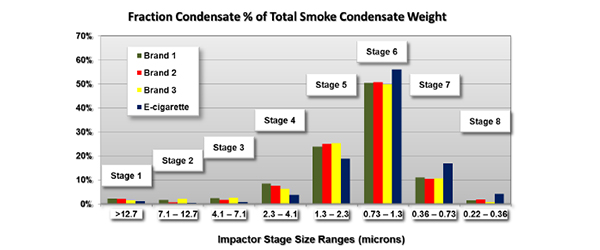
Research shows that the majority of cigarette and e-cigarette aerosol mass falls within the 0.4 to 1.3 micrometer range, meaning these particles can penetrate deep into the lungs where they may cause the most significant health impacts.
3. What makes e-cigarette research particularly important?
The rise of electronic cigarettes has created an urgent need for comprehensive health research. Key research questions include:
- Relative Harm Assessment: Claims that e-cigarettes are "less harmful" than conventional cigarettes require particle-level analysis to validate
- Lung Disease Cases: Recent cases of vaping-associated lung injuries highlight the need for detailed aerosol composition studies
- Long-term Health Effects: The relatively recent introduction of e-cigarettes means long-term health data is limited
Particle size analysis of e-cigarette aerosol warrants specific attention because their aerosol generation mechanism differs significantly from combustion-based cigarettes. The heating elements and liquid formulations in e-cigarettes may produce different particle size distributions, potentially affecting deposition patterns and health outcomes.
4. How does the Mini-MOUDI™ Impactor work for smoke analysis?
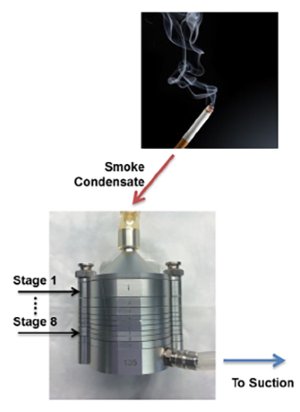 The TSI 135 Mini-MOUDI™ impactor is an advanced instrument for cigarette and e-cigarette aerosol analysis. MOUDI stands for Micro-Orifice Uniform Deposit Impactor. This technology enables precise particle size separation by directing aerosol samples through a series of stages, each equipped with micro-orifices that segregate the particles by size, one size range at a time.
Technical Attributes:
- Small Device Volume: Minimizes sample loss and maintains aerosol integrity
- Low Flow Rates: Operates at 2 liters per minute or less, matching typical smoking puff topographies
- Eight-Stage Separation: Provides detailed particle size distribution across multiple ranges
- Substrate Collection: Uses metal foil or membrane substrates for easy sample recovery
Working Principle: The Mini-MOUDI™ operates as a cascade impactor. As aerosol passes through sequential stages with decreasing jet sizes, larger particles are unable to follow the airstream and deposit on substrates at earlier stages. Smaller particles continue in the flow and are collected on subsequent stages, allowing for detailed fractionation of particle sizes.
Operational Process:
- Stage 1: Captures the largest particles in the smoke condensate
- Successive Stages: Collect progressively smaller particles as air flows through the device
- Final Filter: Captures all the particles that haven’t deposited on any of the stages.
- Sample Recovery: Each stage provides isolated samples for targeted chemical analysis
The Mini MOUDI™ impactor delivers actionable data for health risk assessment. The low flow rates and compact structure support accurate studies with minimal sample volumes.
5. What do research results show about particle distribution?
Recent studies using the Mini-MOUDI™ impactor have revealed important patterns in how cigarette and e-cigarette particles are distributed across different size ranges. Research data indicates that the majority of aerosol mass concentrates in stages 4, 5, and 6 of the impactor, corresponding to particle sizes between 0.4 and 1.3 micrometers.
Size-separated samples enable researchers to map where specific chemicals like nicotine and tobacco-specific nitrosamines deposit. This data provides the foundation for understanding how different smoking products deliver harmful substances to specific regions of the respiratory system. Researchers can now correlate particle size with chemical composition to predict health impacts more accurately.
6. How can this technology advance smoking health research?
The Mini-MOUDI™ impactor opens new possibilities for comprehensive smoking health research by enabling scientists to answer previously difficult questions about smoke composition and delivery. Research applications include:
Regulatory Science:
- Support evidence-based policy decisions about tobacco products
- Provide data for product approval processes
- Enable comparative risk assessments between different smoking products
Clinical Research:
- Correlate particle deposition with specific disease outcomes
- Study individual susceptibility factors based on lung anatomy
- Develop targeted therapeutic interventions
Public Health Studies:
- Assess population-level exposure patterns
- Support smoking cessation program development
- Inform public health messaging and education
Product Development:
- Help manufacturers understand their products' health implications
- Support development of potentially reduced-risk products
- Enable quality control and consistency testing
The ability to separate and analyze smoke by particle size is a valuable advancement in smoking research methodology. It enables studies to move beyond broad assessments to more precise, region-specific analyses, informing both individual treatment decisions and population-level health policies.
7. Ready to enhance your research capabilities?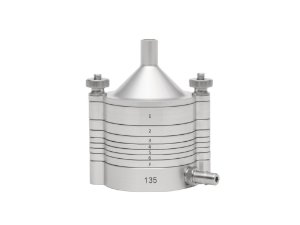
The TSI Mini-MOUDI™ Model 135 impactor provides researchers with the precision tools needed to advance smoking health research. Whether you're studying conventional cigarettes, e-cigarettes, or developing new tobacco products, particle size separation is essential for understanding health impacts. Take the next step in your research:
- Implement particle size analysis in your current studies
- Correlate chemical composition with lung deposition patterns
- Generate data that supports evidence-based health policies
- Advance our understanding of smoking-related health risks
Learn more about the TSI Mini-MOUDI™ Model 135 impactor and request a quote to enhance your smoking research capabilities.
Takeaways for Particle Measurement in Smoking Research
- Particle Size Matters: Different particle sizes deposit in different regions of the respiratory system, affecting health outcomes
- Research Gap: E-cigarette health effects require urgent study as usage continues to grow worldwide
- Technology Solution: The Mini-MOUDI™ impactor enables precise particle size separation for detailed chemical analysis
- Research Results: Most cigarette and e-cigarette particles fall in the 0.4-1.3 micrometer range, reaching deep lung regions
- Future Impact: Size-separated analysis enables more accurate health risk assessments and supports evidence-based policy decisions