 汉语
汉语
 English
 Français
 Deutsch




Direct Answer: Water-based condensation particle counters (WCPCs) have evolved from a distant invention in the late 1900's1 into powerful tools for modern air quality and exposure research, bridging routine ambient monitoring and highly dynamic mobile measurements. Building on innovations that allowed the substitution of butanol with water as a working fluid, today’s WCPCs align with emerging regulatory requirements while offering practical advantages in operation and calibration. The latest generation of versatile WCPCs support long-term ultrafine particle (UFP) monitoring, whereas portable instruments like the OmniCount™ PWCPC extend particle number concentration (PNC) measurements beyond fixed sites, enabling real-world exposure studies in aircraft cabins, vehicles, and urban cycling environments where concentrations can vary by orders of magnitude. Together, these advances show how water-based CPC technology help provide exposure-relevant, spatially resolved insights critical for health, climate, and regulatory science.
Table of Contents
- The History of Water-based Condensation Particle Counting
- WCPCs in Ambient Air Monitoring
- Expanding Beyond Fixed Sites: Mobile PNC Measurements
- Research Results: High Dynamic Ranges in Real-World Environments
- What Mobile Measurements Add to Air Quality Research
- Implications for Health, Climate, and Regulation
- WCPCs from Networks to the Field
1. The History of Water-based Condensation Particle Counting
The measurement of airborne particles has its roots in the late 19th century, when John Aitken demonstrated that supersaturated water vapor could be used to visualize and count atmospheric dust particles. His expansion-type condensation nucleus counter laid the foundation for what would later become condensation particle counting1. Despite this early insight, it took more than a century for water-based condensation particle counters (WCPCs) to become practical, robust tools for routine aerosol research and monitoring.
For decades, condensation particle counters relied almost exclusively on butanol as a working fluid. These instruments proved highly effective and became central to aerosol science, regulatory measurements, and emissions testing. However, they also brought operational challenges, including handling organic working fluids and constraints in certain deployment scenarios.
A major turning point occurred in 2004, when Hering and Stolzenburg introduced a new continuous-flow CPC design that used water instead of butanol2. By reversing the temperature configuration, employing a cooled saturator followed by a heated growth tube, they demonstrated stable particle activation and growth using water vapor alone. This innovation marked the beginning of modern WCPC technology and opened the door to broader applications.
Today, water-based CPCs are not only viable alternatives to butanol systems but are increasingly used in both stationary ambient monitoring networks and emerging mobile measurement applications. This article highlights two key areas of recent advancement:
- The role of WCPCs in standardized, continuous monitoring of ultrafine particles, and
- The expansion of WCPC technology into compact, portable instruments for mobile measurements of particle number concentration (PNC).
2. WCPCs in Ambient Air Monitoring
Ultrafine particles (UFPs), typically defined as particles smaller than 100 nm, have become a central focus in air quality research due to their potential health impacts and their relevance to climate forcing. Particle number concentration (PNC), rather than mass, is now recognized as a critical metric for capturing UFP dynamics.
The revised European standard EN 16976:2024 formalizes requirements for continuous ambient PNC measurements and specifies performance criteria for condensation particle counters used in regulatory and research networks3. While the standard currently prescribes the use of butanol-based CPCs, there is increasing interest in alternative working fluids that are easier to handle, more readily available, and free from potential health or transport concerns.
One widely used water-based instrument in this context is the versatile WCPC Model 3789. This instrument operates with distilled water and is typically calibrated to interchangeable lower detection limits (D50) of 7 nm or 2.2 nm. Its counting efficiency for the smallest particles has been extensively characterized, including detailed studies of sub-10 nm performance.
Custom Calibration to a 10 nm Cut-off Size
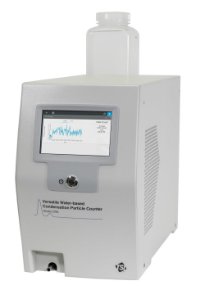 EN 16976:2024 specifies a cutoff size of 10 nm, prompting the need to align WCPC performance precisely with this requirement. The WCPC 3789 offers a custom configuration that allows adjustment of conditioner and initiator temperatures, as well as optical gain, without mechanical modification. Using this flexibility, the instrument can be calibrated to a D50 of exactly 10 nm.
While TSI typically uses sucrose particles for WCPC calibration—chosen for their neutral hygroscopic behavior—the EN standard requires calibration with silver (Ag) particles. Silver aerosols present unique challenges: their activation behavior depends strongly on particle generation conditions, morphology, and surface properties. As a result, they are not always ideal from a fundamental aerosol physics perspective, and are certainly not commonly found in ambient air.
Nevertheless, the intent of the EN standard is not to identify a “perfect” calibration aerosol, but rather to ensure repeatability and comparability between instruments operating in ambient monitoring networks.
Initial results from a silver-based calibration show that a WCPC calibrated to 10 nm can achieve an efficiency curve with both a cutoff and slope comparable to those of a standard butanol CPC used in regulatory networks. When operated in parallel with a fully EN-compliant butanol CPC (such as the TSI CPC 3750-CEN10), the WCPC exhibited instances of both higher and lower reported concentrations.
These deviations cannot be fully explained by differences in size distributions alone, suggesting that calibration aerosol properties and activation physics play a more complex role4. This highlights an open research question: what constitutes an ideal calibration aerosol for ensuring cross-instrument comparability under real ambient conditions?
Parallel Ambient Measurements: WCPC vs. Butanol CPC
To further evaluate real-world performance, the 10 nm-calibrated WCPC was operated in parallel with an EN-compliant butanol CPC during ambient air measurements. This side-by-side comparison provides valuable insight into how different CPC technologies respond to complex, evolving aerosol populations.
Such parallel operation is essential for assessing whether water-based CPCs can be reliably integrated into existing monitoring networks without compromising long-term data continuity. Early results suggest that WCPCs can meet the functional intent of EN 16976, and hence of the revised EU Air Quality Directive5, while also offering practical advantages related to working fluid handling and operational simplicity.
3. Expanding Beyond Fixed Sites: Mobile PNC Measurements
While stationary monitoring stations are indispensable for long-term trend analysis, they provide very limited spatial resolution. Increasingly, researchers and policymakers are seeking spatially resolved PNC data to better understand human exposure, particularly due to near traffic corridors, urban hot spots, and transient emission sources.
Mobile measurements—conducted using backpacks, vehicles, or other platforms—allow researchers to capture sharp gradients in particle number concentrations that fixed stations cannot resolve.
Challenges of Mobile CPC Measurements
Mobile operation introduces several technical challenges for CPCs:
- Sensitivity to motion and tilting
- Limited space and power availability
- The need for short integration times
- Rapid changes in concentration and aerosol composition
Traditional stationary CPCs are often not designed to tolerate these conditions without compromising measurement stability.
OmniCount™ PWCPC: Extending WCPC Technology to Mobile Use
The 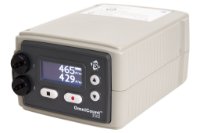 OmniCount™ Portable Water-based Condensation Particle Counter (PWCPC) Model 3002 represents a recent extension of WCPC technology into mobile and field-based applications. Built on the same fundamental condensation principles as stationary WCPCs, OmniCount™ is designed for deployment outside traditional monitoring stations.
To investigate the potential of mobile PNC measurements, a series of traffic-related exposure scenarios were studied using the OmniCount™ PWCPC. The instrument’s compact design, battery operation, and orientation-independent functionality allow it to be deployed in environments where traditional CPC systems are impractical due to size, weight, motion, or safety restrictions related to working fluids.
The study focused on three primary scenarios:
- Commercial passenger flights
- (Parallel) measurements inside and outside a passenger car
- Cycling in urban traffic situations
In all cases, total particle number concentrations above 10 nm were measured. The goal was to assess concentration dynamics and exposure variability rather than detailed chemical composition. For that reason, no differentiation between solid and non-solid particles was made in these studies.
4. Research Results6: High Dynamic Ranges in Real-World Environments
 Particle Number Concentrations During Commercial Flights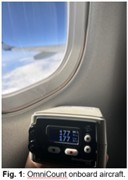
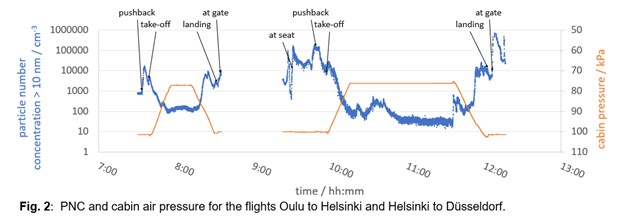
Measurements conducted during commercial flights revealed an exceptionally wide dynamic range in particle number concentrations. While the aircraft was at the gate, PNC values frequently exceeded 200,000 particles/cm³, and in some cases reached levels above 500,000 particles/cm³, depending on airport conditions, aircraft handling, and meteorology.
Once the aircraft reached cruising altitude, particle concentrations dropped significantly, often falling below 100 particles/cm³. These low concentrations are consistent with cleaner air at altitude and efficient cabin air filtration.
Notably, the OmniCount™ PWCPC operated reliably at cabin pressures down to approximately 75 kPa, its specified minimum operating pressure and a condition characterized during instrument development. This defined performance range helps ensure stable operation under typical commercial flight conditions. In addition, the use of water as the working fluid enables deployment on commercial aircraft, avoiding the restrictions and handling limitations associated with alcohol-based CPCs such as butanol or IPA.
 Inside and Outside a Passenger Car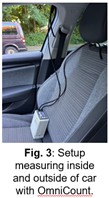
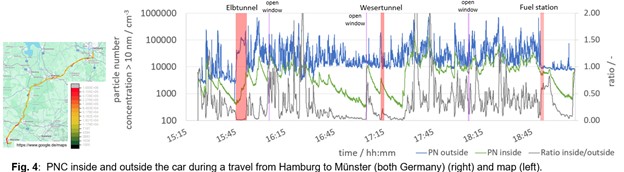
Mobile measurements conducted during highway travel showed consistently high particle number concentrations outside the vehicle, ranging dynamically from 500 to 800,000 particles/cm³. Inside the car, concentrations were significantly lower, averaging about one-third of the outdoor levels, though still highly variable.
Short-term events had a pronounced impact on measured concentrations. Driving through tunnels, changes in traffic density, and variations in vehicle speed produced sharp concentration spikes both inside and outside the vehicle.
The effectiveness of the vehicle’s air conditioning and filtration system varied depending on operational mode and environmental conditions. Over the duration of the measurements, the average filtration efficiency was approximately 66%, with short-term efficiencies reaching as high as 99% when assessed using a moving average.
Please note that this measurement setup did not differentiate between solid and volatile (semi-volatile) particles.
 Cycling in Urban Traffic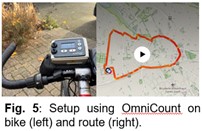
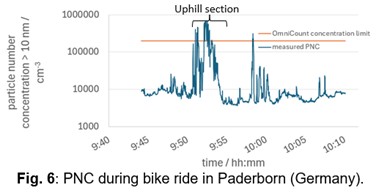
Mobile measurements conducted during a bicycle ride in Paderborn (Germany) revealed highly dynamic particle number concentrations (PNC), ranging from approximately 3,600 particles/cm³ to values exceeding 670,000 particles/cm³ Because the measurements being performed on a Sunday, when overall traffic volumes were comparatively low, pronounced concentration peaks were observed. These peaks could be clearly linked to localized high-emission sources, such as nearby diesel-powered light commercial vehicles, as well as specific driving conditions including uphill road sections. The results highlight the strong influence of short-term, localized emission events on personal exposure levels during cycling, under generally favorable traffic conditions.
5. What Mobile Measurements Add to Air Quality Research
The results demonstrate the relevance of mobile, personal exposure measurements for understanding traffic-related UFP concentrations. The observed particle number concentrations span several orders of magnitude, even within a single measurement campaign, emphasizing the limitations of relying solely on fixed-site data.
At present, the measurements focus on total particle number concentrations above 10 nm. Future studies that differentiate between solid and non-solid particles would help clarify emission sources and formation mechanisms. Similarly, separating results by vehicle type, fuel technology, and air conditioning system design could provide valuable insights for exposure mitigation.
The OmniCount™ PWCPC’s ability to operate in any orientation and tolerate motion makes it adaptable to a wide range of study designs, from in-cabin monitoring to pedestrian and cyclist exposure assessments.
6. Implications for Health, Climate, and Regulation
The ability to measure ultrafine particle number concentrations reliably—both at fixed sites and in mobile settings—has important implications:
- Health research: Improved understanding of exposure patterns at the scale where people live and commute
- Air quality management: Better identification of emission hot spots and evaluation of mitigation strategies
- Climate studies: Enhanced characterization of particle sources relevant to cloud formation and radiative forcing
- Regulatory science: Stronger technical foundations for future standards that may incorporate mobile or hybrid monitoring approaches
Water-based CPC technology is increasingly positioned to support these needs, complementing established butanol-based systems rather than replacing them outright.
7. WCPCs from Networks to the Field
From Aitken’s early condensation experiments to today’s routine monitoring networks and mobile platforms, CPC technology continues to evolve. Modern WCPCs demonstrate that water-based condensation is not only viable, but adaptable across a wide range of measurement scenarios.
Stationary WCPCs calibrated in alignment with EN 16976 requirements support long-term ambient monitoring, while portable instruments like the OmniCount™ PWCPC extend ultrafine particle measurements into real-world environments where spatial variability and exposure matter most.
As demand grows for more detailed, exposure-relevant particle number data, WCPC technology—both fixed and mobile—will play an increasingly important role in advancing aerosol science, air quality management, and health-related research.
More About the OmniCount™ PWCPC Model 3002
References
[1] Aitken, J. (1890). On a simple pocket dust-counter. Proc. R. Soc. Edinb., XVIII, 39-53.
[2] Hering, S. V., & Stolzenburg, M. R. (2004). Continuous, Laminar Flow Water-based Particle Condensation Device and Method. U.S. Patent 6,712,881, issued March 30, 2004
[3] EN 16976:2024. Ambient air - Determination of particle number concentrations of atmospheric aerosol
[4] Bischof, O.F., Tritscher, T., Ruether, T., Bock, N., Schmitt, S.H., Kykal, C. (2025). Latest Advances in Water-based Condensation Particle Counters (WCPC), 14th Asian Aerosol Conference (AAC), Mumbai, India, December 3, 2025
[5] Directive (EU) 2024/2881 of the European Parliament and of the Council of 23 October 2024 on ambient air quality and cleaner air for Europe (recast)
[6] F. Dahlkötter, T. Tritscher, O. F. Bischof and C. Kykal (2026) "Mobile Measurement of Particle Number Concentrations of Traffic-Related Emissions", NOSA Symposium 2026: Impacts of Aerosol Science & Technology, Lund (Sweden), 2026.