 汉语
汉语
 English
 Français
 Deutsch




Direct Answer: This application note shows that industrial 3D printing can produce elevated ultrafine particle concentrations in the breathing zone, with emissions varying throughout the print process. Real-time particle sizing and concentration measurements help reveal these dynamic patterns, supporting better exposure assessment and improved ventilation strategies for safer workplace operation.
Table of Contents
- What are 3D printer emissions and why do they matter?
- Measurement Approach: Capturing Real-Time Particle Emissions
- Experimental Setup: Realistic Breathing Conditions
- Results: Elevated Particle Concentrations in the Breathing Zone
- Implications: What do these results mean for workplace safety?
- Why high-resolution particle measurement matters
- Conclusion & Key Takeaways
- Frequently Asked Questions (FAQs)
1. What are 3D printer emissions and why do they matter?
Additive manufacturing has moved well beyond prototyping and is now firmly established across industries ranging from aerospace and automotive to healthcare and advanced manufacturing. As industrial 3D printing becomes more integrated into daily operations, attention is increasingly shifting toward occupational exposure—particularly to airborne particles generated during printing.
Standards such as ANSI/CAN/UL 2904, “Standard Method for Testing and Assessing Particle and Chemical Emissions from 3D Printers”, provide guidance for evaluating emissions from desktop systems commonly used in offices, schools, and homes. The standard outlines methods for measuring both particle and chemical emissions, helping organizations better assess exposure risks and implement mitigation strategies in indoor environments.While emissions from desktop 3D printers have been widely studied, far less data exists for industrial systems, despite their long-standing use. This gap is important. Industrial printers often operate for extended periods, process larger material volumes, and are used in environments where worker exposure can occur regularly. Understanding the characteristics of these emissions, especially in the breathing zone, is essential for assessing potential risks and designing appropriate mitigation strategies.
A key challenge is that emissions from 3D printing are not steady. Particle generation tends to occur in bursts, influenced by material type, print geometry, and process conditions. At the same time, emitted particles often fall within the ultrafine range (below 100 nm), where health relevance and measurement complexity both increase. Capturing these transient and size-dependent dynamics requires instrumentation capable of both high temporal resolution and detailed size distribution analysis.
2. Measurement Approach: Capturing Real-Time Particle Emissions
To accurately characterize emissions in such a dynamic environment, measurement approaches must resolve both rapid concentration changes and particle size distributions across the ultrafine range. In this study, two complementary techniques were used to monitor emissions in the breathing zone of a worker positioned near an industrial 3D printer.
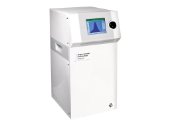 Engine Exhaust Particle Sizer™ (EEPS™) Spectrometer Model 3090
Measures particle size distributions from 5.6 to 560 nm at a time resolution of 10 measurements per second. This capability makes it particularly suitable for capturing short-lived emission events, such as those occurring during specific phases of the print process.- Condensation Particle Counter (CPC) Model 3776
 Tracked total particle number concentrations for particles larger than 2.5 nm, with a response time of approximately 0.8 seconds. Together, these instruments provide a combined view of both total concentration and detailed size-resolved behavior, enabling a more complete understanding of emission dynamics.
3. Experimental Setup: Realistic Breathing Conditions
The Printer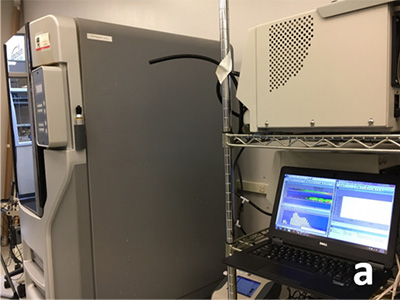
An industrial 3D printer (Dimension sst 1200es) was used for particle emissions measurement. The 3D printer used ABS (acrylonitrile butadiene styrene) as its feedstock. ABS is one of the most common feedstocks in 3D printing. The printer also utilizes a water-soluble support material, which acts as a scaffold. Overhanging features of the 3D printed object (such as a shelf) are supported during the print by a fast-curing support material. After the print is complete, the part is soaked in warm water to dissolve away the scaffold. The printer used in this work utilized an acrylic copolymer support material.
The Printed Object
The objected printed during this study was small and square in shape [~2.25 inches long on all sides, and ~0.2 inches thick (ABS portion only)]. Printing this object entailed printing 10 layers of the water- soluble support material followed by 10 layers of the feedstock (acrylonitrile-butadiene styrene, ABS). The final ABS object (after the water-soluble material was dissolved away) had a mass of 10.4 g.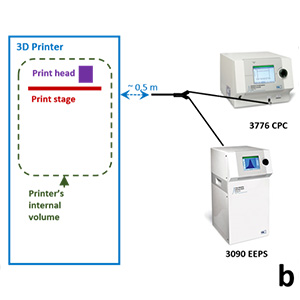
Emissions Measurements
To investigate potential worker exposure to 3D printer emissions, measurements were taken outside of the printer while this small object was printed. Figure 1a depicts the 3D printer as well as the particle measurement instruments, with the sampling tube sampling air from a worker’s breathing space.
During a print, approximately 0.5 m from the printer’s exterior wall. Tubing lengths were scaled to instruments’ flow rates to align the transfer times of the aerosols to the instruments and are not shown to scale in this schematic.
4. Results: Elevated Particle Concentrations in the Breathing Zone
1. Rapid Increase in Particle Number Concentration
The measurements revealed that particle emissions in the breathing zone increased significantly during active printing, particularly during the deposition of support material. Time-resolved data showed a clear rise in particle number concentration that coincided closely with the onset of this phase.
The agreement between total particle counts measured by the CPC and those derived from the EEPS size distributions was strong, providing confidence in the observed trends. This alignment also highlights the benefit of combining fast-response concentration measurements with high-resolution size data.
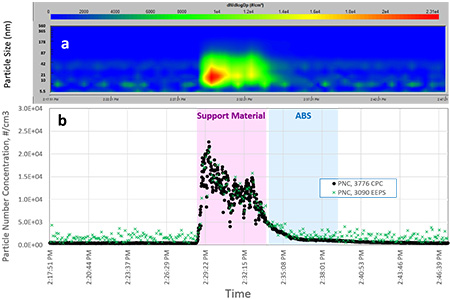 |
Fig. 1: a) EEPS contour plot of particles measured in the worker's breathing space. b) A time series of particle number concentrations as measured by the 3776 CPC and the 3090 EEPS. The time ranges of the contour plot in (a) and the Particle Number Concentration time trace in (b) are identical, so the “plume” shown in the contour plot occurred simultaneous to the printing of support material. |
2. Ultrafine Particle Dominance
Looking more closely at particle size distributions, the emissions were dominated by ultrafine particles. The most frequently observed particle size (mode) was at or below 25 nm, with peak concentrations often centered around approximately 15 nm during active printing phases. These findings are consistent with previous research on polymer-based 3D printing emissions, where nucleation and condensation processes generate large numbers of nanoscale particles.
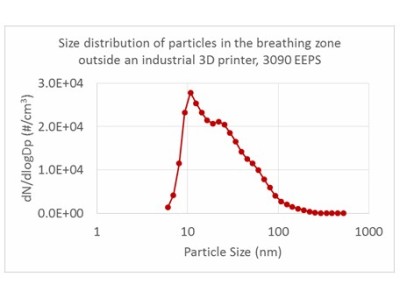 |
Fig. 2: A size distribution of particles measured during the support material print. The peak of the size distribution represents particles approximately 15 nm in size. |
3. Time-Resolved Emission Behavior
The contour plots generated by the EEPS instrument further illustrate how these particles evolve over time. Rather than a steady emission profile, the data shows distinct plumes corresponding to specific print activities. This reinforces the importance of high time resolution when studying such processes—lower-resolution instruments could easily miss these transient but potentially significant exposure events.
5. Implications: What do these results mean for workplace safety?
These findings reinforce the importance of monitoring particle emissions in environments where industrial 3D printers are used. Given the dynamic nature of emissions, continuous or high-time-resolution monitoring is more informative than occasional spot measurements.
Ventilation plays a critical role in mitigating exposure. Both local exhaust systems and general room ventilation can help reduce particle concentrations, but their effectiveness depends on system design, airflow patterns, and operational settings. Real-time particle monitoring can support the evaluation and optimization of these controls.
In addition, understanding when emissions occur, such as during specific print phases, can inform operational practices. For example, minimizing operator presence during high-emission periods or adjusting process parameters may help reduce exposure.
6. Why high-resolution particle measurement matters
The ability to capture both rapid concentration changes and detailed particle size distributions is essential for understanding complex emission sources like 3D printers. Instruments such as the EEPS and CPC used in this study provide complementary insights that would be difficult to obtain with a single measurement approach.
High temporal resolution allows researchers to link emissions directly to process events, while size-resolved data provides context for interpreting potential impacts and identifying underlying mechanisms. Together, these capabilities enable a more complete and actionable understanding of aerosol behavior in real-world environments.
7. Conclusion & Key Takeaways
This study demonstrates that industrial 3D printing can generate elevated concentrations of ultrafine particles in the breathing zone of nearby workers, with emissions varying significantly over time and across different stages of the printing process. The combination of fast-response concentration measurements and high-resolution particle sizing reveals emission patterns that would otherwise remain hidden.
As additive manufacturing continues to expand, integrating advanced aerosol measurement techniques into workplace assessments will be increasingly important. Doing so not only supports a better understanding of exposure but also provides a foundation for improving ventilation strategies, operational practices, and overall workplace safety.
Key Takeaways
- Industrial 3D printers emit ultrafine particles in the breathing zone
- Emissions are highly dynamic and process-dependent
- Particle sizes are predominantly <25 nm, relevant for health exposure
- Real-time measurement is essential to capture short-lived emission peaks
- Monitoring and ventilation are critical for reducing worker exposure
8. Frequently Asked Questions (FAQs)
Do 3D printers emit harmful particles?
Yes, both desktop and industrial 3D printers can emit ultrafine particles, especially during heating and material extrusion.
What particle sizes are emitted during 3D printing?
Primarily ultrafine particles (<100 nm), with peaks often around 15–25 nm.
Where should emissions be measured?
In the breathing zone (~0.5 m from the printer) to assess real worker exposure.
Why is high time resolution important?
Because emissions occur in short bursts that can be missed by slower instruments.
How can exposure be reduced?
Through improved ventilation, filtration, and real-time monitoring of particle concentrations.