 汉语
汉语
 English
 Français
 Deutsch




Table of Contents
Airborne hazards in the workplace represent a silent, often invisible risk to workforce health. From respirable crystalline silica dust on a construction site to solvent vapors in a manufacturing plant, the air workers breathe can carry long-term health consequences.
For occupational hygienists and safety managers, the objective is clear: accurately quantify these hazards to determine whether control measures are effective. This process, known as exposure monitoring, provides the data required to make informed decisions that reduce risk. However, the reliability of this data rests entirely on the precision of the equipment used to collect it.
While the sampling head or filter often receives the most attention, the personal air sampling pump is the engine of the assessment. If the pump fails to maintain a constant flow rate, the calculated volume of air sampled will be incorrect, rendering the exposure concentration calculation invalid.
This article explores the technical intricacies of personal sampling pumps, the importance of adherence to standards such as ISO 13137: 2022, and how advanced solutions like the Casella Apex2 and Casella VAPex support accurate personal exposure assessment.
The Role of Personal Air Sampling
Personal air sampling is the gold standard for assessing an individual’s exposure to hazardous substances. Unlike static or area monitoring, which measures the general environment, personal sampling measures the air in the worker’s “breathing zone” — defined as a hemisphere of 30 cm from the mouth and nose.
As well as ensuring compliance with regulations, exposure monitoring is typically required when:
- Identify health risks such as respiratory illness or chemical toxicity
- Assess workers’ exposure to hazardous substances (dust, fumes, gases, vapors)
- There is a serious risk to health if control measures fail
- Control measures need to be checked for effectiveness
Capturing Representative Data
By attaching a sampling train — consisting of a sampling head, tubing, and a pump — to the worker, safety professionals can capture a representative sample of what is actually being inhaled during a shift. This applies to particulates (dusts, fumes, mists) as well as gases and vapors. The pump’s role is to draw air through the collection media at a known, specific rate.
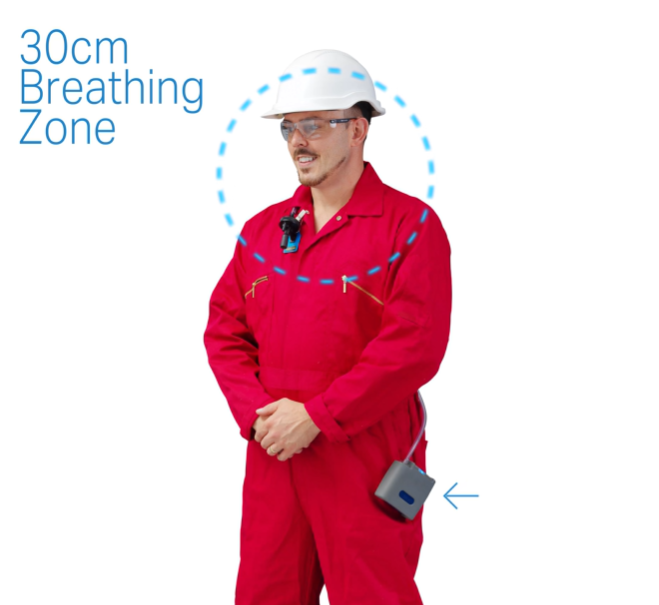
A typical personal air sampling train setup within the breathing zone.
The formula for calculating airborne concentration is mass divided by volume. The laboratory determines the mass of contaminant collected, but the volume is calculated by multiplying the pump’s flow rate by the time sampled. If the pump’s flow rate fluctuates or drifts, the volume calculation becomes inaccurate, and the resulting exposure data is compromised.
ISO 13137: Setting the Standard for Performance
To assist safety professionals in selecting equipment that delivers reliable data, the International Organization for Standardization developed ISO 13137. This standard specifies performance requirements for personal air sampling pumps.
Compliance with ISO 13137 is not merely a label; it is an indication that the pump can withstand the rigours of real-world working environments while maintaining measurement accuracy. The standard covers several critical performance criteria, including:
- Flow stability: The pump’s ability to maintain a set flow rate over time
- Back pressure capability: The ability to pull air against resistance
- Pulsation: The smoothness of the airflow
- Environmental conditions: Flow must be maintained through changes in temperature and pressure
When selecting a pump for regulatory compliance and defensible exposure data, choosing a model that meets ISO 13137 requirements helps support the credibility and legal robustness of monitoring results.
Key Features for Accurate Measurement
For a sampling pump to meet the specification detailed in ISO 13137, it must possess certain technical capabilities. Understanding these features enables safety managers to select equipment that will perform consistently in the field.
Flow Stability and Internal Flow Measurement
Environmental conditions in the workplace can change rapidly. Temperature fluctuations, atmospheric pressure changes, and worker movement can all affect pump performance. A high-quality sampling pump must maintain its set flow rate within ±5% throughout the sampling period.
Automated Flow Control
Modern pumps use internal flow measurement and control systems that continuously monitor airflow and automatically adjust motor speed to compensate for changing conditions. This “set-and-forget” capability is critical in practice. If a pump drifts outside the 5% tolerance, the sample may be rejected as invalid. Advanced pumps also log this data, providing a digital audit trail that verifies flow stability throughout the shift.
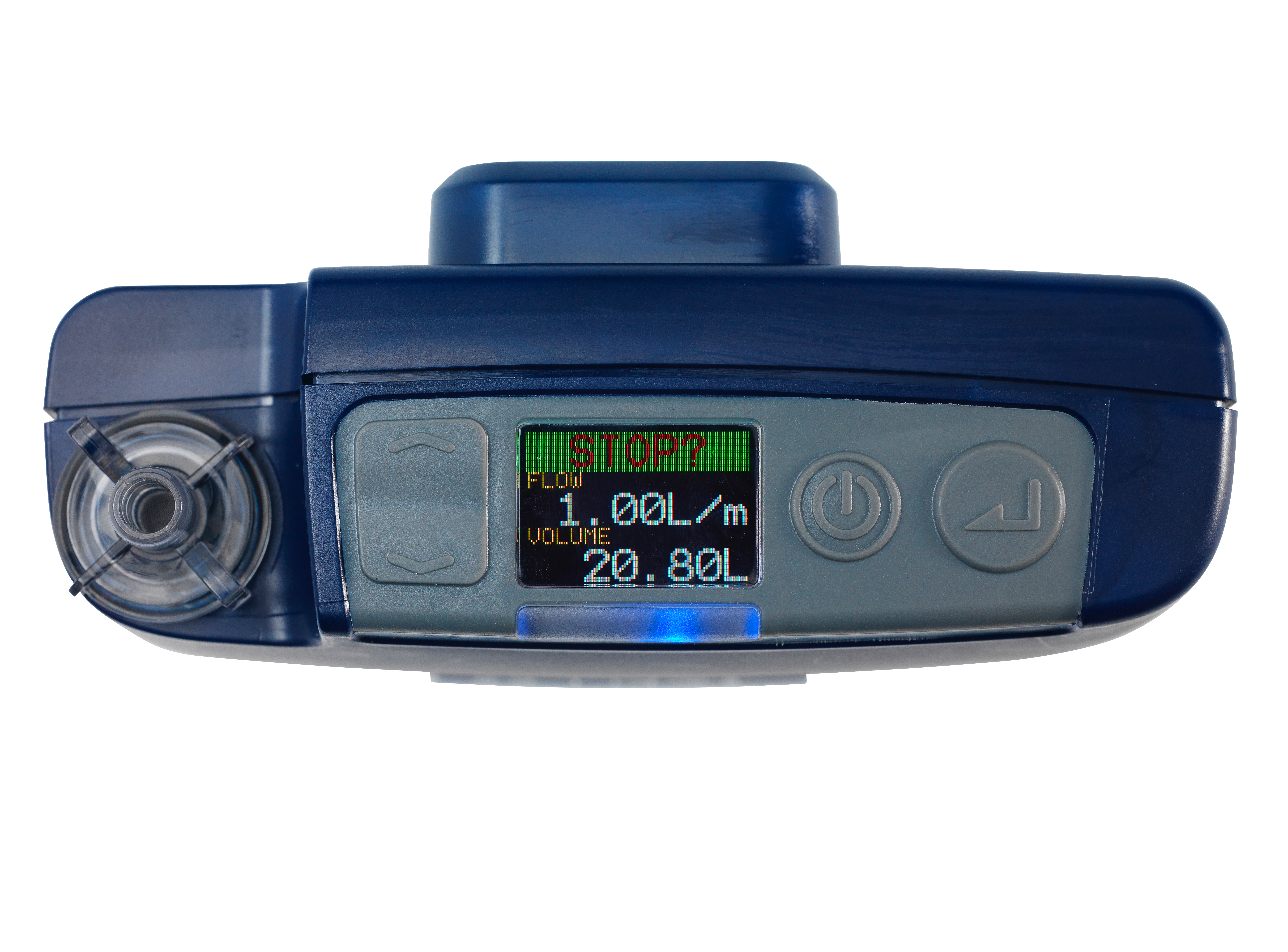
Digital interfaces provide real-time verification of flow stability.
Internal Back Pressure Compensation
One of the most significant challenges in particulate sampling is filter loading. As dust accumulates on the filter, resistance increases. This rising back pressure is similar to a vacuum cleaner bag filling up: as resistance grows, the motor must work harder to maintain airflow. If the pump cannot overcome this resistance, flow rate drops and the sampled volume becomes inaccurate.
ISO 13137 requires pumps to maintain flow against defined back pressures. This is especially important in high-dust environments such as construction, quarrying, or mining. Pumps with robust back pressure compensation detect increased resistance and increase motor power automatically to maintain a constant flow rate.
Minimizing Pulsation with Dampers
Diaphragm pumps generate airflow in pulses, much like a heartbeat. Excessive pulsation can interfere with size-selective sampling heads such as cyclones, which rely on a stable air velocity to separate respirable particles from larger ones.
High-quality pumps incorporate internal dampers to smooth airflow, creating a more laminar flow pattern. ISO 13137 sets limits on acceptable pulsation levels to help ensure consistent cyclone performance and accurate particle size selection.
Environmental Conditions
ISO13137 defines a range of environmental conditions the pump should maintain flow accuracy. The pump’s flow rate must not deviate by more than ±5 % of its set value when operating across a range of temperatures — from cold, up to elevated temperatures up to 40 °C. For pressure changes, the pump is tested over a pressure range of approximately 80 kPa to 106 kPa (simulating different altitudes).
This is to ensure in a working environment such as a factory, going, for example indoors or outdoors, does not alter set flow. In more challenging environments, such as mines with large temperature and pressure changes, this is even more important.
Field Calibration Capability
Although internal flow control is essential, it does not replace calibration. Best practice requires pumps to be calibrated before and after each sampling run using a separate, traceable flow reference.
If post-sampling flow deviates by more than 5% from the pre-sampling value, the sample may be considered invalid. Easy field calibration — without bulky equipment — improves compliance and reduces the likelihood of unusable data.
Air Sampling Equipment
Precision Exposure Monitoring with Casella
Ensure compliance and reliable data with Casella's comprehensive range of personal air sampling pumps and calibrators. From the high-flow Apex2 for dust to the VAPex for vapors and the automated Flow Detective, equip your team with ISO 13137 compliant solutions tailored for accuracy.
Explore Casella Pumps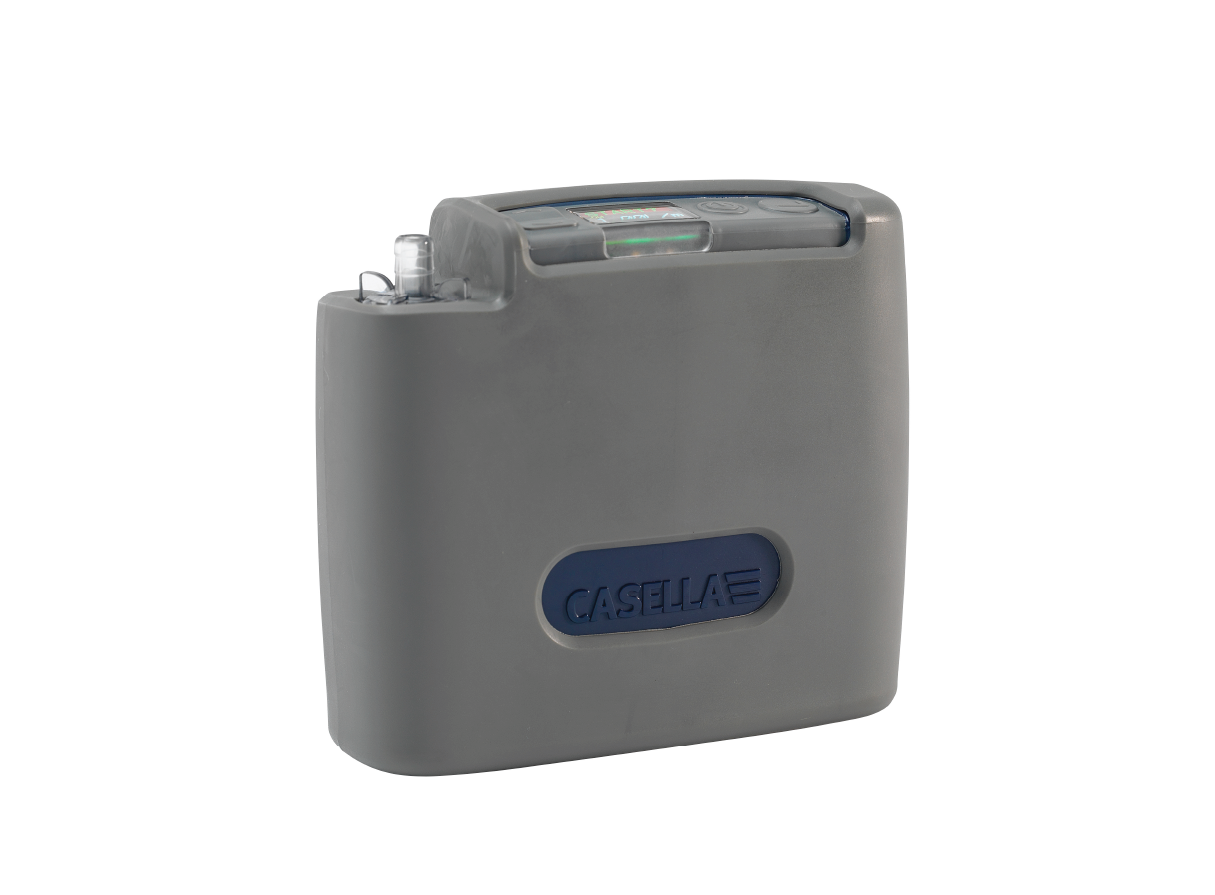
Casella Solutions for Exposure Assessment
Casella offers air sampling pumps that meet the ISO 13137 standards, to support safety professionals in gathering defensible exposure data. These tools combine robust engineering with digital connectivity to simplify fieldwork and data management.
Apex2: Personal Air Sampling
The Apex2 range is designed specifically for personal exposure sampling, with a flow rate of 1 to 5L/min ideal for dust measurements. These pumps have high back-pressure capability allowing reliable sampling, even in heavy dust loading conditions. Models are Intrinsically Safe for use in flammable atmospheres. Learn More
VAPex: Precision for Vapors and Gases
For low-flow (up to 500mL/min) applications such as volatile organic compounds and solvent vapors, the VAPex provides a purpose-built solution with intrinsically safe models to support use in potentially explosive environments. Learn More
Flow Detective: Closed Loop Calibration
To complete the sampling system, the Flow Detective provides a robust field calibration and closed-loop calibration with the Apex2 or VAPex, automating setup and reducing human error and setup time. Learn More
Summary
Accurate exposure assessment is the foundation of effective occupational health management. It transforms safety from assumption to evidence-based decision-making. Yet the quality of exposure data is only as good as the equipment used to collect it.
By using personal sampling pumps that comply with ISO 13137 — offering stable flow control, strong back-pressure compensation, low pulsation, all across a range of environmental conditions — health and safety professionals can trust their measurements. Casella’s Apex2 and VAPex pumps, supported by the Flow Detective calibrator, form an integrated system that supports defensible exposure monitoring. Investing in high-quality sampling instrumentation reduces the risk of invalid data, strengthens regulatory compliance, and ultimately contributes to safer, healthier workplaces.
Frequently Asked Questions
What is a personal air sampling pump?
A personal air sampling pump is a critical tool used to assess an individual worker's exposure to hazardous airborne substances. It works by continuously drawing air through collection media at a specific, known rate from within the worker's breathing zone.
Why is flow stability important in air sampling?
Flow stability is critical because the calculated volume of sampled air depends entirely on a constant flow rate. If the pump's flow rate fluctuates, the calculated volume becomes inaccurate, rendering the entire exposure concentration measurement invalid and unreliable.
What is the worker's breathing zone?
The worker's breathing zone is defined as a hemisphere with a 30-centimeter radius extending from the individual's mouth and nose. Sampling air directly from this specific area provides the most representative measurement of the hazardous substances the worker actually inhales.
What is ISO 13137?
ISO 13137 is an international standard that specifies performance requirements for personal air sampling pumps. It ensures pumps can withstand real-world working environments while maintaining strict measurement accuracy, covering criteria like flow stability, pulsation, and back pressure capability.
How does back pressure affect an air sampling pump?
Back pressure restricts airflow as dust and particulates accumulate on the sampling filter. A compliant sampling pump must automatically detect this increased resistance and boost motor power to maintain a constant flow rate, ensuring accurate volume calculations despite heavy filter loading.
Why do sampling pumps need internal dampers?
Internal dampers are necessary to minimize airflow pulsation generated by the pump's diaphragm. Smoothing the airflow creates a laminar pattern, which is crucial for size-selective sampling heads like cyclones to accurately separate respirable particles from larger, non-respirable ones.
Do environmental conditions affect sampling pump performance?
Yes, fluctuations in temperature and atmospheric pressure can significantly affect a sampling pump's performance. High-quality pumps are designed and tested to maintain flow accuracy within ±5% across varying environmental conditions, including temperature changes and altitude differences.
Is field calibration required for air sampling pumps?
Yes, field calibration is required before and after each sampling run using a traceable flow reference. This process verifies that the pump's flow rate has not deviated by more than 5% during the shift, ensuring the collected data is valid and defensible.
What is the Casella Apex2 used for?
The Casella Apex2 is designed specifically for personal exposure sampling of dust and particulates. It operates at a flow rate of 1 to 5 liters per minute, features high back-pressure capabilities, and offers intrinsically safe models for flammable atmospheres.
What applications are suitable for the Casella VAPex pump?
The Casella VAPex is purpose-built for low-flow air sampling applications, typically up to 500 milliliters per minute. It is specifically designed to accurately capture volatile organic compounds (VOCs) and solvent vapors, making it ideal for potentially explosive environments.