 汉语
汉语
 English
 Français
 Deutsch




Table of Contents
- Understanding the ISO 14644-1 Standard
- The Certification Challenge
- The Role of Real-Time Monitoring Systems
- Transforming Data into Compliance Strategy
- Supporting Operational Efficiency and Risk Reduction
- Selecting the Right Monitoring Solution
- Conclusion: Investing in Quality and Reputation
- Frequently Asked Questions
In the high-stakes world of precision manufacturing, the margin for error is microscopic. Whether producing semiconductors, aerospace components, or medical devices, the environment in which these products are manufactured is just as critical as the materials used to build them. A single airborne particle can compromise product integrity, leading to costly yield losses and reputational damage.
To manage these risks, manufacturers rely on controlled environments defined by strict international standards. Chief among these is ISO 14644-1, the global benchmark for classifying air cleanliness. Achieving and maintaining compliance with this standard is not merely a regulatory checkbox; it is a fundamental requirement for demonstrating credibility and meeting customer expectations for quality.
However, certifying a cleanroom is not a one-time event. It requires a commitment to ongoing vigilance. This is where robust cleanroom monitoring systems prove essential. By providing continuous data on environmental parameters, these systems help manufacturers maintain the stringent cleanliness levels required for certification. This article explores the critical role of monitoring technology in supporting compliance, reducing operational risk, and upholding market competitiveness.
Understanding the ISO 14644-1 Standard
ISO 14644-1 focuses on the classification of air cleanliness by particle concentration. It dictates the maximum allowable number of particles per cubic meter of air for various particle sizes. The standard establishes distinct classes, ranging from ISO Class 1 (the cleanest) to ISO Class 9, with each class representing a specific level of permissible contamination.
For precision manufacturers, understanding where their facility falls within this classification matrix is the first step toward quality control. A facility manufacturing sensitive optical lenses may require an ISO Class 5 environment, while a general assembly area might operate under ISO Class 7 or 8 standards.
The Certification Challenge
Certification involves demonstrating that the cleanroom performs within the specified limits of its class. Traditionally, this involved periodic testing — often every six or 12 months — where a third-party certifier would take manual measurements. While this snapshot approach validates that the room met standards at the exact moment of testing, it leaves a significant gap in knowledge regarding the room's performance during the months between certifications.
This "blind spot" poses a risk. If a filtration system begins to degrade or a seal fails weeks after a certification visit, the manufacturer might continue production in a compromised environment without realizing it. Cleanroom monitoring systems help bridge this gap, offering a stream of data that supports a state of continuous control.
The Role of Real-Time Monitoring Systems
A robust cleanroom monitoring system does more than just count particles; it acts as the central nervous system of the controlled environment. These systems integrate various sensors to track critical parameters continuously, providing a holistic view of cleanroom performance.
Particle Counting
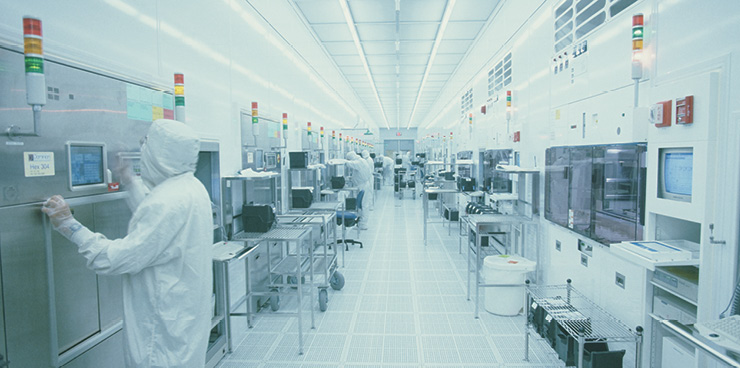
The primary metric for ISO 14644-1 is airborne particle concentration. Automated particle counters installed at critical locations sample the air continuously. This real-time data allows facility managers to see immediate spikes in contamination, which might indicate a process failure, a gowning protocol breach, or equipment malfunction. By identifying these trends early, operators can intervene before the contamination reaches a level that would jeopardize the cleanroom's classification status.
Automated particle counters provide continuous environmental data.
Differential Pressure
To keep contaminants out, cleanrooms must maintain positive pressure relative to adjacent, less clean areas. If the pressure drops, dirty air from the outside can infiltrate the controlled zone. Monitoring systems track pressure differentials across standard doorways and pass-throughs. Alerts can notify personnel immediately if pressure relationships drift out of specification, allowing them to address the issue before it impacts the manufacturing process.
Temperature and Relative Humidity
While not always explicitly tied to the particle count limits of ISO 14644-1, temperature and humidity are vital for process stability and static control. In electronics manufacturing, for example, low humidity can increase the risk of electrostatic discharge (ESD), which can destroy sensitive components. Conversely, high humidity can lead to oxidation or microbial growth. Integrated monitoring systems track these environmental factors alongside particle counts, helping manufacturers maintain a stable production environment.
Monitoring Solution
AeroTrak® Portable Particle Counters
Ensure your cleanroom strictly complies with ISO 14644-1 standards using TSI’s AeroTrak® Portable Particle Counters. The A100 Series and 9110 models provide industry-leading accuracy, intuitive interfaces, and secure data logging to eliminate blind spots between certifications and guarantee continuous environmental control.
Explore AeroTrak® Series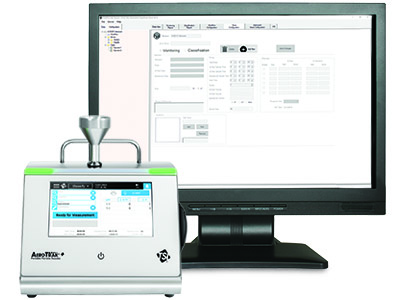
Transforming Data into Compliance Strategy
Collecting data is only half the battle; utilizing that data to support certification is where the true value lies. Modern monitoring software compiles vast amounts of environmental data into actionable insights that streamline the path to compliance.
Automated Reporting and Audit Readiness
Preparing for an audit or a recertification visit can be a labor-intensive process involving the manual aggregation of paper records and spreadsheets. This manual approach increases the risk of human error and data gaps.
Advanced monitoring systems automate this process. They generate comprehensive, secure reports that visualize trends over time. When an auditor asks for evidence of environmental control over the past year, facility managers can produce detailed reports with a few clicks. This capability demonstrates a high level of process control and helps build trust with auditors and regulatory bodies.
Improving Data Integrity
In regulated industries, data integrity is paramount. Regulators and customers need to know that the environmental data presented is accurate and has not been altered. Modern monitoring solutions assist with data integrity by employing features such as audit trails, user access controls, and secure databases. These features help manufacturers align with data integrity principles, such as those outlined in ALCOA+ (Attributable, Legible, Contemporaneous, Original, and Accurate), which are increasingly relevant across all high-precision sectors.
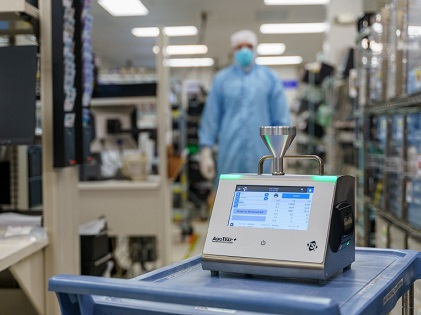
Secure monitoring dashboards ensure ALCOA+ data integrity.
Supporting Operational Efficiency and Risk Reduction
While compliance is the primary driver for implementing monitoring systems, the operational benefits extend significantly further. A well-implemented system helps reduce the cost of quality and improves overall facility efficiency.
Early Detection of Excursions
In a facility relying solely on periodic certification, a ventilation failure might go unnoticed for days. During that time, every product manufactured is potentially suspect. This scenario can lead to massive batches of scrap material, expensive rework, or, in the worst-case scenario, a product recall.
Continuous monitoring enables a proactive approach. By setting alert limits that are tighter than the official ISO class limits, operators receive early warnings when conditions begin to drift. This "warning" stage allows maintenance teams to investigate and rectify minor issues — such as a sash left open or a fan needing adjustment — before they escalate into critical failures that halt production.
Optimizing Maintenance Schedules
Cleanroom operations are energy-intensive, primarily due to the HVAC and filtration systems required to maintain air cleanliness. Without data, facility managers often rely on rigid, time-based maintenance schedules. For example, they might replace HEPA filters every six months, regardless of the filters' actual condition.
Monitoring data supports a move toward predictive maintenance. By analyzing trends in particle counts and pressure drops across filter banks, managers can determine exactly when a filter is nearing the end of its life. This data-driven approach helps avoid premature replacements, reducing maintenance costs and minimizing planned downtime.
Enhancing Personnel Discipline
Human activity is often the largest source of contamination in a cleanroom. When operators know that the environment is being monitored in real time, it encourages better adherence to gowning protocols and movement procedures. Furthermore, the data can be used as a training tool. If a specific shift consistently correlates with higher particle counts, management can provide targeted retraining to address the behaviors contributing to the contamination.
Selecting the Right Monitoring Solution
Not all monitoring systems offer the same level of support for ISO 14644-1 compliance. When evaluating potential solutions, precision manufacturers should consider several key factors to ensure the system meets their specific needs.
Scalability and Flexibility
Manufacturing needs change. A facility might expand, or a process might be reconfigured to accommodate a new product line. The monitoring system should be scalable, allowing for the easy addition of new sensors and sampling points without requiring a complete system overhaul. Wireless capabilities can also be advantageous, offering the flexibility to move sensors to hard-to-reach areas without running extensive cabling.
Sensor Accuracy and Calibration
The reliability of compliance data depends entirely on the accuracy of the sensors. Manufacturers should look for systems that utilize high-quality laser particle counters and precise environmental sensors. Additionally, the system provider should offer robust support for calibration services. Sensors that drift out of calibration yield unreliable data, which can compromise the validity of the facility's certification status.
User-Friendly Interface
A complex system that is difficult to navigate will likely be underutilized. The software interface should be intuitive, providing clear visualizations of the cleanroom layout and current status. Alarms should be unmistakable and provide clear information regarding the location and nature of the excursion, enabling rapid response times.
Conclusion: Investing in Quality and Reputation
In the competitive landscape of precision manufacturing, quality is the currency of trust. ISO 14644-1 certification serves as the gold standard for verifying that a facility is capable of producing sensitive components without contamination. However, certification is not merely a badge to be displayed; it represents a continuous commitment to environmental control.
Cleanroom monitoring systems are the cornerstone of this commitment. By providing continuous, accurate data on environmental parameters, these systems help manufacturers maintain compliance, reduce the risk of product loss, and streamline the audit process. They transform environmental monitoring from a reactive burden into a proactive strategic asset.
Implementing a robust monitoring solution does more than satisfy a regulation. It empowers manufacturers to take control of their production environment, thereby helping to safeguard their reputation and deliver the high-quality products their customers demand. In an industry where precision is everything, reliable monitoring is the tool that makes consistent precision possible.
Monitoring Solution
Cleanroom Monitoring Applications
Learn More About Cleanroom Monitoring with TSI
Explore Cleanroom Monitoring
Frequently Asked Questions
What is ISO 14644-1?
ISO 14644-1 is the global standard for classifying air cleanliness in controlled environments based on airborne particle concentration. It dictates the maximum allowable particles per cubic meter, establishing classes from ISO Class 1 to ISO Class 9 to ensure manufacturing environments meet strict quality requirements.
Why is cleanroom certification important?
Cleanroom certification proves that a facility meets specific ISO 14644-1 cleanliness standards, which is essential for ensuring product quality. It demonstrates to customers and regulators that the controlled environment actively prevents microscopic contamination from compromising sensitive products like semiconductors and medical devices.
What is the main limitation of periodic cleanroom testing?
The primary limitation of periodic cleanroom testing is that it only validates performance at the exact moment of the test. This creates a blind spot between certification visits, where undetected filtration failures or contamination events can compromise production without the manufacturer's knowledge.
How do real-time monitoring systems support ISO compliance?
Real-time monitoring systems continuously track environmental parameters like particle concentration, pressure, and temperature. This constant stream of data allows facility managers to detect contamination spikes immediately, ensuring the cleanroom remains in a state of continuous control to maintain its ISO classification.
Why monitor differential pressure in a cleanroom?
Monitoring differential pressure ensures that cleanrooms maintain positive pressure relative to adjacent, less clean areas. If pressure drops, contaminated outside air can infiltrate the controlled zone, making continuous pressure monitoring critical for immediate intervention and maintaining environmental integrity.
Why are temperature and humidity monitored in cleanrooms?
Temperature and humidity are monitored because they are vital for process stability and static control. Incorrect humidity levels can cause electrostatic discharge, oxidation, or microbial growth, which can destroy sensitive components like electronics during the high-precision manufacturing process.
How do advanced monitoring systems help with cleanroom audits?
Advanced monitoring systems automate the creation of comprehensive, secure reports that visualize environmental trends over time. This eliminates manual data aggregation, reduces human error, and provides auditors with immediate, verifiable evidence of continuous environmental control and compliance.
What features ensure data integrity in cleanroom monitoring?
Data integrity in cleanroom monitoring is ensured through features like secure audit trails, strict user access controls, and encrypted databases. These functionalities guarantee that environmental data is accurate, attributable, and tamper-proof, aligning with stringent ALCOA+ regulatory data principles.
How does continuous monitoring optimize cleanroom maintenance?
Continuous monitoring optimizes maintenance by enabling predictive, data-driven schedules instead of rigid time-based replacements. By analyzing trends in pressure drops and particle counts, managers can determine exactly when HEPA filters need replacing, reducing unnecessary costs and planned downtime.
What should manufacturers look for in a cleanroom monitoring solution?
Manufacturers should look for a highly scalable solution with exceptionally accurate sensors, robust calibration support, and a user-friendly interface. These features ensure the system can adapt to facility changes while providing reliable, easily interpretable data for rapid response to contamination alerts.